Showing posts with label #stophate. Show all posts

Monday, 5 August 2013

Proud to be part of PRIDE

Earlier this year I posted a blog about gay rights. With the debate about same-sex marriage high on the national and media agenda, it seemed like a good opportunity to put down some thoughts and ideas about gay and lesbian issues.

With same-sex marriage now finally working its way on to the statute book, it got me thinking a little more about the cloak of invisibility which still seems to surround LGBT issues in the public sector – and I suppose in society at large. Even here at Wolverhampton Homes, where I like to think we have a culture of openness and acceptance, I still get the impression that there’s a reluctance from some colleagues to be open and comfortable at work about who they are.

I’m very much of the opinion that people who are free to be themselves at work will perform better – it seems like a no brainer to me.  Of course, some colleagues will say ‘my work is my work and my private life is my private life – never the two shall meet! I get that – and I totally understand that. What worries me is that there could be colleagues who feel they can’t be themselves because they don’t know how others will react. I’ve no evidence to suggest this is the case – but if it were, that really saddens me.
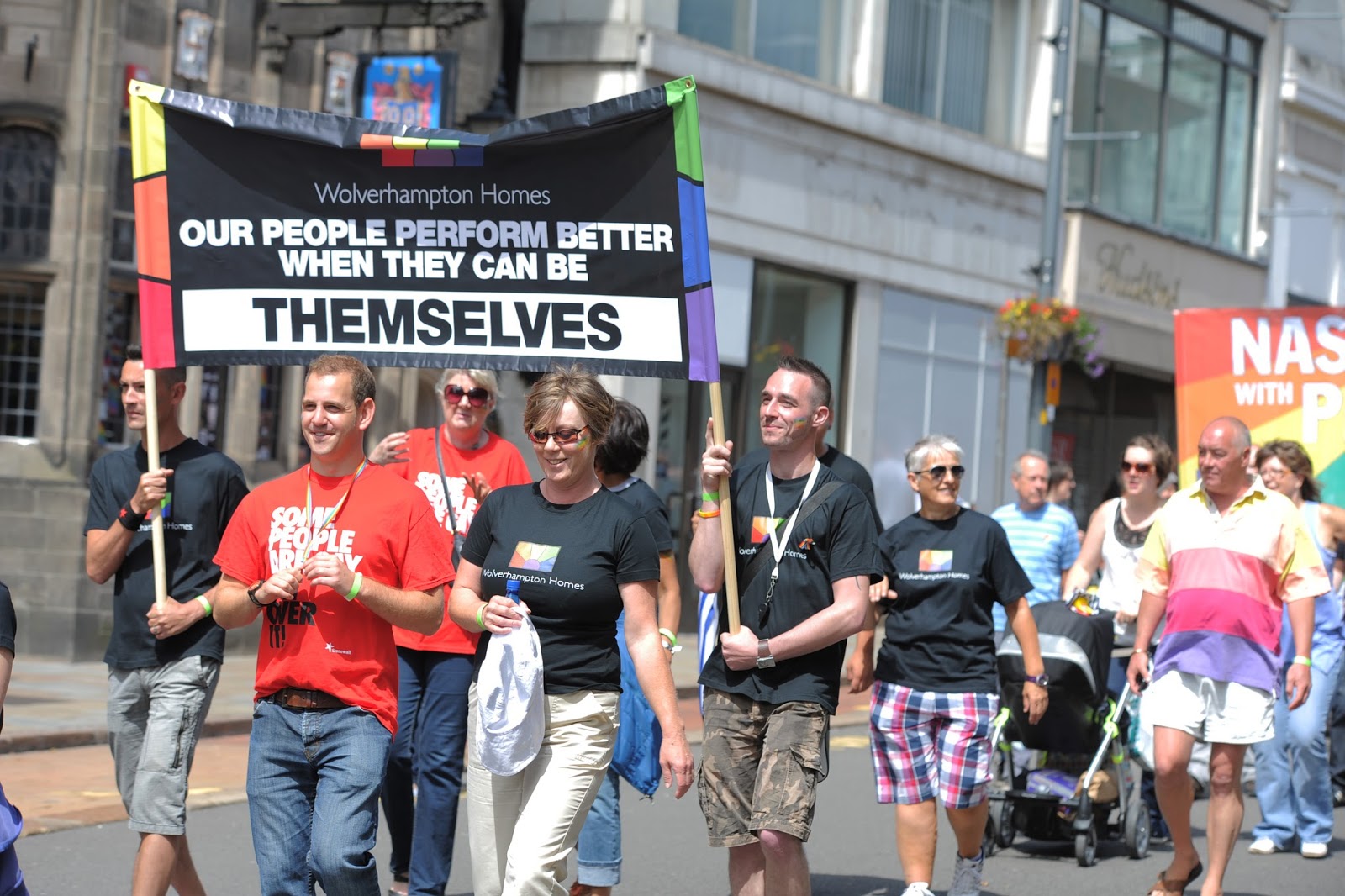
Wolverhampton Homes staff taking part in the PRIDE parade
Last weekend I was really proud to see a dozen or so of my colleagues parading through Wolverhampton City Centre, taking part in the city’s second annual Pride festival. Some of our contingent were gay – but what I found heart-warming was seeing other colleagues who aren’t gay turning up to support the cause. What a wonderful show of unity and support.

It was interesting to speak with one straight colleague who took part in Pride who’d been a bit wary as to how the crowd and passers-by may react. But he said the shoppers in Wolverhampton were great. It was also really heartening to see our local newspaper, The Express & Star, covering the Pride parade in such a positive light.

Being gay isn’t a scandal anymore for people in public life. There are openly gay senior police officers and openly gay politicians. Even in sport, the barriers are coming down slowly. Rugby star Gareth Thomas has helped and perhaps some time in the not-too-distant future, perhaps football will follow-suit? The Justin Fashanu fallout lives long in the memory but I hope in time one high profile footballer comes out and they’re shown the support and respect that their courage deserves.

Our people perform better when they can be themselves
I’m proud that we’ve been able to team up with Stonewall, the gay-rights charity, as we bid to become an accredited gay-friendly place of work. I’m proud to be supporting the LGBT community in Wolverhampton and I’m proud to be supporting gay members of staff here at Wolverhampton Homes. Attitudes seem to be changing – and although there’s a long way to go, I want Wolverhampton Homes to be leading the way and want our colleagues to be proud of who they are.


Tuesday, 24 January 2012

Join us to stop hate crime in Wolverhampton

You may be remember last year I wrote this post about a series of Get Togethers we held to ask tenants about hate crime.

At those events, tenants told us that people didn’t know what hate crime or hate incidents were and those that did know said they wouldn’t want to report it. They also said that we needed to do more to raise awareness.

So today, we’re launching a year-long campaign called Stop Hate in Wolverhampton. We’re asking you to join us and pledge to stop hate. Please sign up to our pledge, like our facebook page and show your support on your social media profile with a twibbon.

Hate crime is when people are abused through a perceived prejudice on the part of the perpetrator. It can be linked to disability, sexuality, age, race, gender or ethnicity. Only 18 hate crimes were reported to Wolverhampton Homes last year and nationally, it is thought that for every hate crime that is reported, eight go un-reported.

Hate crime can include physical assault or even murder, but can also include verbal attacks, graffiti or vandalism.

You may not realise but the majority of hate crimes happen near to the victim's home while they are going about their daily business and most hate crime perpetrators live in the same neighborhood as their victims.

That’s really a startling thought – just where people should feel safest – in their own neighbourhood is where they are most likely to suffer hate crime.

Our tenants are adamant that we must do more to ensure people know what hate crime is and that we do all we can to stop it happening.

Please join us and pledge to Stop Hate in Wolverhampton.

Facts and figures you may not know about hate crime:

  • Figures released by the police in 2010 showed an increase in the amount of recorded hate crime last year, including a near doubling of disability hate crime.
  • There were 52,028 reported hate crimes last year up on an estimated 46,300 in 2008. Disability hate crimes increased from 800 to 1,402 over the same period.  However, according to 'Stop Hate UK' over 80% of all hate crimes are not reported to the police.
  • More than half (56 per cent) of the disabled people in Scope’s online sample said they had experienced hostility, aggression or violence from a stranger because of their condition or impairment (Scope, 2011).
  • Sixteen per cent of almost 2,000 people with learning disabilities who responded to a Community Care survey in 2007 said they had been bullied on the street in the previous year.
  • Research by the mental health charity Mind in 2007 showed that 71 per cent of respondents had been victimised in the community at least once in the past two years and felt this to be related to their mental health history.
  • Around 40 per cent of LGB people say they are worried about being the victim of a crime (Homophobic Hate Crime, 2008).
  • The findings from Homophobic Hate Crime, 2008 suggest that one in eight of lesbians and gay men and one in 20 bisexuals had experienced a hate crime or incident in the year to February 2008.
  • Disabled people being four times more likely to be the victim of a crime than other people and twice as likely to be the victim of a violent attack.