Tuesday, 12 August 2014

Robin Williams RIP


Mental Health – there must be more we can do

Robin Williams. RIP

I, like millions of others, woke up this morning to hear the exceptionally sad news that the much-loved comedian and actor Robin Williams had died.

A man who literally made millions of us laugh has left an indelible mark on the world of entertainment and the childhoods of many. From Good Morning Vietnam to the Dead Poets’ Society and from Jumanji to Mrs Doubtfire; Williams was an accomplished actor with seemingly boundless energy and humility.

But beneath the laughter lay a man riddled with doubt, insecurity and a dark, desperate depression. Well documented battles with drugs, alcohol and mental health have seemingly finally taken their toll.

It leads me to think about mental health and the stigma which is still attached to it – not only in society but in the workplace too. If someone you know breaks their leg, their plaster cast is a visual reminder that’s something’s wrong and that person may need some help. But with mental health the signs aren’t always so clear and the problems not so easily understood.

In a world where the pace of life seems to get faster and faster as the days go by, it seems we often forget to ask the simple questions of others around us; how are you? Are you feeling ok? Do you need to talk?

Millions are suffering in silence and there’s a desperate need for more to be done. Statistics suggest that one in six workers in the UK suffer with some sort of mental health problem – whether it’s anxiety, depression or stress. That suggests more than 100 of my staff could be suffering – many in silence; and that just doesn’t seem right to me.

We need to do more to support people with mental health problems. Here at Wolverhampton Homes we have a counselling service which I hope is of use to colleagues who feel they might need it. But I suspect many who really do need it don’t come forward because they simply don’t want anyone to know. We need to deal with that mind-set – not just here but in society as a whole. We all need to do more and create a culture where we can talk openly about mental health.

Today I’m going to email all of my staff and remind them that we have services that can help – and that there are people out there like the Samaritans and countless others groups who can help.

We need to change our attitudes towards mental health. Let’s start that now.

Tuesday, 17 June 2014

Stay Safe. Stay Put


Earlier this week we launched a new fire safety campaign on our high rise estates.

We’ve got 48 high rise tower blocks in Wolverhampton and the nightmare for every housing organisation or local council is that a tower block goes up in flames.

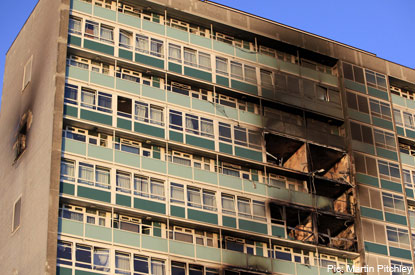
Lakanal House in 2009
The Lakanal House fire in Southwark in 2009 is a lasting reminder about how fires in tower blocks can be so dangerous. Six people died as a fire spread through a flat on the 9th floor. There were a multitude of failings that day.

The advice from fire safety experts is fairly simple - if there’s a fire in a communal area in a tower block…stay put. We all know that our natural instincts are to try and get out but in these instances, unless you’re told by the fire service to move – you should stay put.

That’s because the flats were built to withstand fire. The concrete shells of each flat can withstand heat of several hundred degrees. And with the latest standard fire doors installed, the odds of the fire coming into a flat from a communal area is greatly reduced.

We’ve seen for ourselves how much damage fire can cause in a high rise block. Last year there was a fire in the communal lobby at Longfield House in Wednesfield. It’s sobering viewing when you see the CCTV footage to think how quickly the fire spread and how lucky we were that no one was hurt – let alone killed.

Stay Safe. Stay Put.
We also saw a fire in another block of flats in Wednesfield last year. This was confined to one flat – but it really hits home about how important it is to have a plan for when fire strikes in your home.

So this week we’re launching our Stay Safe, Stay Put message for tenants living in high rise blocks. Before we started the campaign we did a quick survey and this is what we found:
  • 40% of people don’t check their fire alarm weekly 
  • Nearly half had never heard of the stay put policy
This tells me that there’s still work or us to do.

That’s why every high rise flat will be getting a leaflet, a sticker for their front door and a phone call over the next 6 weeks.

With people’s lives at risk – it’s so important we get that message out there.

I’ll let you know how the campaign goes – but in the meantime, let me leave you with this footage from Longfield House…how long do you think it takes for the fire to spread?


Tuesday, 3 June 2014

‘Elf and Safety’ – excuses mask serious issues


If you’ve had one of those weeks and you really need cheering up then take five minutes to visit the Health & Safety Executive’s website and check out their myth-busting pages. They’re an absolute hoot!

The HSE's myth-busting page is well worth a visit
So far there are 285 cases on their website where companies have used ‘health and safety’ as an excuse for not doing something.

For years we’ve heard about the kids being banned from playing conkers at school and that everything is ‘elf and safety gone mad!’

But what these health and safety myths and excuses are actually doing is detracting from a really serious point. In 2012/13 148 people lost their lives at work. 148 people went to work in the morning but never came home. That’s why health and safety is important.

At Wolverhampton Homes, we’re responsible for keeping our staff safe. That’s around 750 people – plus the 23,000 homes we’re responsible for in the city and our contractors. That’s actually a huge responsibility and one which we really do take seriously. Sadly - and this may come as shock to some; accidents do happen. With that many people, some using pretty dangerous machinery at times, people are bound to have a near miss or have that momentary lapse in concentration which we all have from time to time. You’ll never stop accidents from happening. But what you can do is put things in place to minimise those risks.

Last week, we had a visit from ROSPA (the Royal Society for the Prevention of Accidents). They came in to look at our health and safety procedures and policies and so on. I met with their assessors last week and I was so proud to hear that we’ve been awarded ROSPAs Level 3 Award. A lot of hard work has gone into helping us achieve this and I’m so grateful for the hard work of our excellent health and safety team.

You mention health and safety to someone and they either roll their eyes or give that slightly glazed look. And this isn’t because people don’t care about safety – if you give me a chainsaw I want to know how to use it so I don’t lop my arm off! But it’s because over the years ‘elf and safety’ has been given such a bad rep because people use it as convenient excuse to either not do something or to not practice a bit of common sense.

We do live in a more litigious environment and I understand why people can be so cautious. But sometimes just a few simple measures and a touch of common sense could avoid a lot of unnecessary hassle and angst.

So – my plea is this: health and safety matters. It’s important and it saves lives so treat it seriously, use a bit of common sense and don’t use it as an excuse which trivialises something which is so important.

In the meantime, check out the HSE’s website – my personal favourite is not stocking plasters in a First Aid box!